

How Do CPG Brands Improve EBITDA Margins?
CPG brands improve EBITDA by closing three leaks: undisciplined trade spend, invalid retail deductions that go undisputed, and slow cash conversion from unresolved deductions sitting on the balance sheet. Growing revenue without fixing these three areas means margin keeps compressing even as the top line grows.
TL;DR
- Trade spend runs 15% to 25% of gross sales for most CPG companies, and EBIT margins for top CPGs remain near a 10-year low despite price increases averaging more than 20% since Q3 2021, a trend tracked in Bain & Company's 2024 Consumer Products Report.
Why Does EBITDA Matter More Than Revenue for CPG Brands?
Revenue growth means little if trade spend, deductions, and operational costs grow faster than the top line. A CPG brand can grow revenue 20% and still watch EBITDA shrink because margin leakage rarely appears as a single line item. It accumulates across hundreds of distributor invoices and retailer chargebacks every month.
EBITDA is also the metric investors, acquirers, and lenders actually price a business on. Fixing margin moves the valuation multiple; fixing revenue alone does not.
For most CPG brands, trade spend is the largest variable cost on the P&L. When deductions go uncontested and promotional spending lacks visibility, that cost compounds and grows unchecked. Recovering cash that was already earned through disciplined deduction management is one of the fastest paths to a stronger EBITDA story.
What's Driving Margin Pressure at CPG Brands Right Now?
CPG brands are under margin pressure from three directions at once: rising input costs, retailers demanding more promotional support, and consumers trading down to private label. Private label grocery sales grew 3.9% in 2024, hitting a record $271 billion (Circana data cited by the Private Label Manufacturers Association), and that shift shows no sign of reversing.
Despite price increases averaging more than 20% since Q3 2021, EBIT margins for top CPGs remain near a 10-year low, as documented in Bain & Company's 2024 Consumer Products Report. COGS growth matched or outpaced those price increases. That erased the margin gains brands expected from raising prices.
Trade spend keeps climbing as a share of net revenue for brands selling through major retail chains. CPG vendors routinely lose 1% to 3% of total gross sales to shortage claims and compliance penalties alone (Supply Chain Digest), and 65% to 80% of retail shortage claims are invalid (Retail Value Chain Federation data). Based on Glimpse's analysis across clients, invalid deductions overall account for roughly 3% of retail revenue before most finance teams see the full picture.
The key takeaway is that this pressure feels structural, but most of it is recoverable. The rest of this article breaks down exactly where that recoverable margin is hiding and how to get it back.
What Is the Gross-to-Net Waterfall, and Why Does It Matter for EBITDA?
The gross-to-net waterfall is the sequence of deductions applied to gross revenue before it becomes net revenue: trade spend, promotional allowances, slotting fees, co-op advertising, and retailer deductions. Glimpse's analysis of client invoice data finds this waterfall removes 20% to 30% of topline revenue before a single operating expense is counted for many mid-market brands.
The sequence flows in order: gross sales minus trade spend, promotional allowances, slotting fees, co-op advertising, and retailer deductions leaves net revenue. From there, COGS and operating expenses compress what remains into EBITDA.
Invalid deductions get written off instead of disputed. Over-accrued trade funds go unreconciled for months. Promotional allowances get taken by retailers without proof the promotion actually ran. Freight charge discrepancies add another layer of hidden loss. None of this shows up as a line item labeled "money you lost." It just disappears into the math.
In practice, EBITDA gets compressed twice: once in the waterfall through write-offs and over-accruals, and again through the labor cost of managing all of it manually.
How Does Reducing COGS Protect Gross Margin?
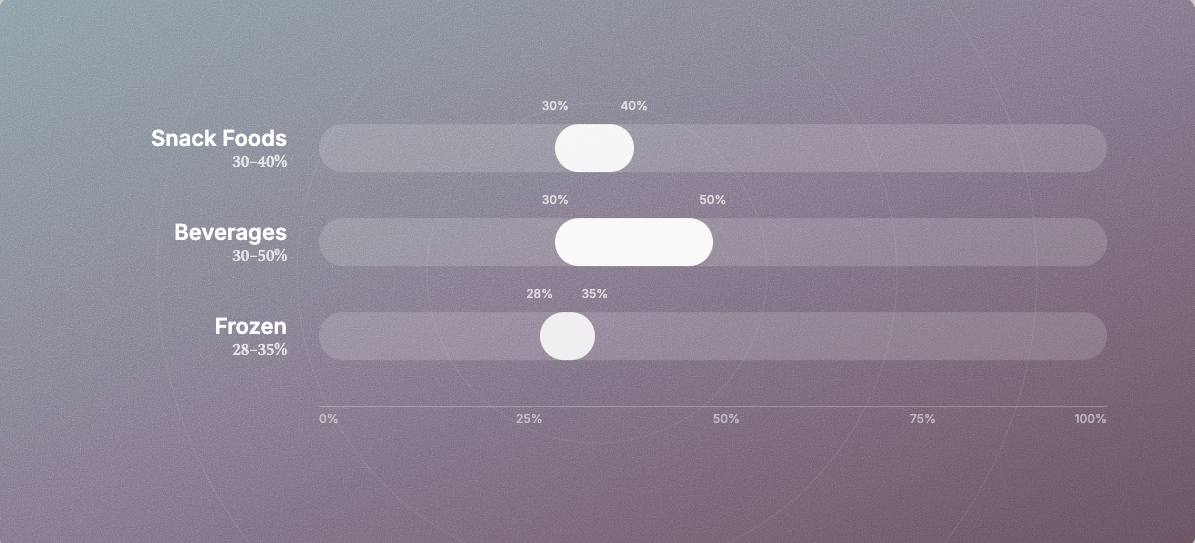
Reducing COGS protects gross margin because COGS typically runs 50% to 70% of revenue depending on category (snack foods run 30% to 40% gross margin, functional beverages 30% to 50%, and frozen foods 28% to 35%), so even a 2 to 3 percentage point improvement flows directly to the bottom line. COGS growth matched or exceeded those price increases, per Bain's 2024 Consumer Products Report, eroding the margin gains brands expected from raising prices. The three most impactful levers are sourcing, formulation, and co-packer contract renegotiation.
Brands that renegotiate co-manufacturing contracts annually instead of letting them auto-renew, especially as volume grows, put one of the fastest levers for COGS reduction to work. Even modest pricing adjustments compound quickly at scale. Ingredient substitution, where product quality allows, can move the needle further without any consumer-facing impact.
Where SKU Rationalization Fits In
Carrying low-velocity SKUs that share production runs with core products quietly inflates per-unit overhead. Most rationalization efforts start by reviewing the bottom tier of the portfolio by margin contribution, often the lowest-performing 10% to 15% of SKUs, and asking whether each one earns its shelf space. Brands that pair SKU discipline with end-to-end deduction management recover margin from multiple directions simultaneously.
How Can CPG Brands Improve Trade Spend ROI?
CPG brands improve trade spend ROI by auditing which promotions actually drive volume versus which ones only generate deductions. Trade spend is often the largest line item on a CPG brand's P&L, and McKinsey found that 59% of trade promotions are unprofitable.
Most finance teams treat trade spend as a fixed cost of doing retail. It isn't. Getting rigorous about promotion performance requires clean post-event data, and most teams work with incomplete pictures because backup documentation never gets pulled or reconciled in time.
Here's why that matters: if a promotional event ran and the deduction came through but you can't confirm the lift actually occurred, that's a dispute opportunity, not a cost to absorb. Start by auditing the top 10 retail accounts against actual lift data before expanding the audit further.
How Do CPG Brands Recover Revenue Lost to Invalid Retail Deductions?
CPG brands recover revenue lost to invalid deductions by disputing shortage claims filed without backup, promotional deductions taken on deals that never ran, and pricing discrepancies across retailer portals, instead of writing them off. Retail deductions are the most common source of margin leakage for CPG brands, and a large share of them are invalid.
Most finance teams either lack the bandwidth to dispute every deduction or write off anything under a set dollar threshold just to keep the queue moving. Based on data from Glimpse's client work, brands routinely auto-write off deductions below $1,000 to $2,000 due to capacity constraints. One leading cosmetics brand wrote off anything under $1,300, a pattern detailed in the Belcam Beauty deduction recovery case study, and a national snack portfolio only reviewed deductions over $2,000, leaving six figures in recoverable revenue unreviewed annually.
Glimpse disputes invalid deductions on a brand's behalf, with AI agents handling volume and human experts making judgment calls at the edges. Brands using Glimpse see a revenue lift of roughly 2.5%, cash that was already earned, not new revenue that has to be won.
How Can CPG Brands Cut Operational Overhead in Finance and AR?
CPG brands cut finance and AR overhead by automating the repetitive parts of deduction management: pulling backup documentation, classifying deduction types, flagging invalid claims, and filing disputes before deadlines expire, while reserving human review for edge cases. Finance and AR teams at CPG brands are often stretched thin manually reconciling deductions and chasing backup across dozens of retailer portals, and that overhead compounds fast when a brand scales into new retail channels.
Brands can manage a growing deduction volume without adding headcount while maintaining recovery rates. Lower labor costs in AR, fewer write-offs, and faster dispute resolution all compress the cost side of the ledger while simultaneously recovering revenue that was already earned. Both effects show up directly in EBITDA.
How Does Reducing DSO Accelerate Cash Conversion?
Reducing Days Sales Outstanding (DSO) accelerates cash conversion because unresolved deductions keep the underlying invoice unreconciled, which stalls manual cash application and traps working capital on the balance sheet. Brands in manufacturing-distribution channels, the closest proxy for CPG, typically see DSO of 45 to 60 days (Credit Pulse's 2025 industry benchmarks), and unresolved deductions are a bigger driver of that number than most finance teams realize.
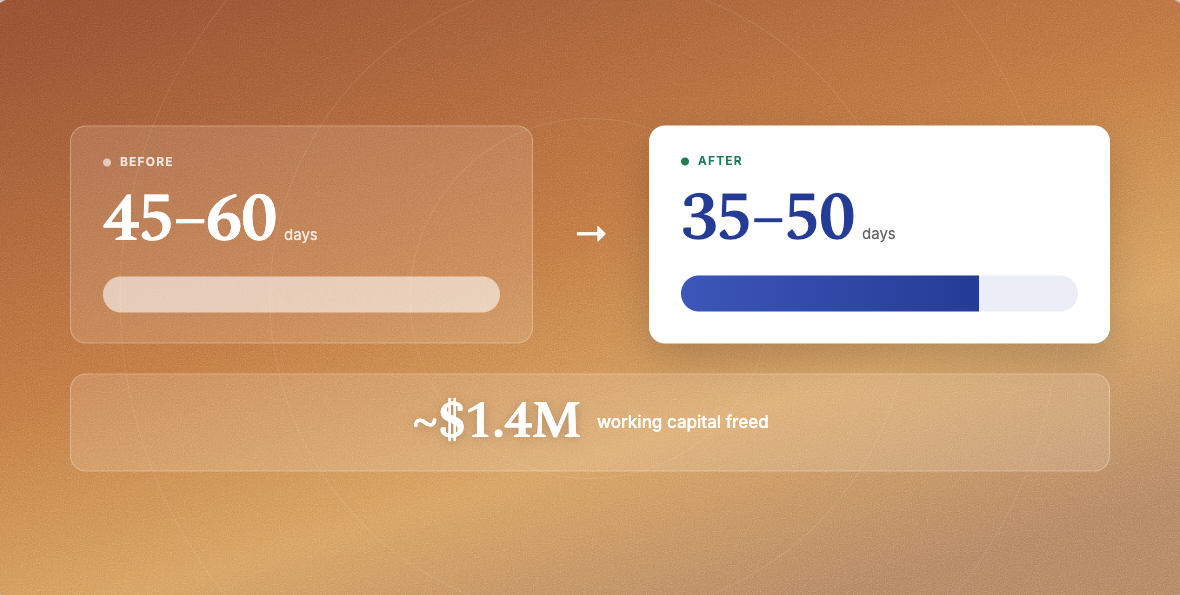
Same-day payment matching and automated deduction resolution close that gap: for a brand with $500M in annual revenue, every day of DSO reduction frees approximately $1.4M in working capital, using the standard Annual Revenue ÷ 365 formula. A 5- to 10-day improvement moves real, usable capital. Lower DSO also compresses borrowing costs and speeds up financial close, which matters directly when investors or lenders are reviewing the books.
How Do CPG Brands Build Retailer-Level and SKU-Level Profitability Visibility?
CPG brands build retailer-level and SKU-level visibility by stacking trade spend, deductions, and contribution margin into a P&L for every retailer and SKU combination, instead of relying on blended, company-wide averages. Most CPG brands can report their total gross margin. Far fewer can identify which specific retailer is quietly destroying it.
That gap is where margin leakage hides. A SKU that performs well at one retailer might be underwater at another once that retailer's deduction rate, slotting fees, and promotional lift requirements are factored in.
What Do Channel-Level P&Ls Actually Reveal?
Channel-level P&Ls reveal which trade dollars are earning a return by stacking four layers for every retailer and SKU:
When these four layers are stacked, underperforming channels become impossible to ignore.
Why Are Most Brands Flying Blind on Channel Profitability?
Most brands are flying blind because the underlying data is fragmented across systems that were never built to talk to each other. The data exists inside the ERP, distributor portals, and deduction management workflows: finance sees AR, sales sees velocity, and trade sees spend, but nobody looks at the combined picture by retailer and SKU simultaneously. Closing that gap is what separates brands that defend margins from those that watch them compress quarter after quarter.
How Does Glimpse Help CPG Brands Improve EBITDA?
Glimpse improves CPG brand EBITDA by running the full deduction-recovery cycle: AI agents scan every invoice and deduction, flag invalid charges, and file disputes before deadlines close, while human experts review edge cases and escalate where judgment matters. The output is recovered cash, not a report telling a finance team what to chase next.
The results hold across brands of different sizes. One brand recovers 97% of deductions with Glimpse. Clients see margin expansion of around 175 basis points, which flows straight to EBITDA.
Glimpse also handles scale without added headcount, processing up to 4.3 times the dispute volume a typical internal team manages, which keeps finance and ops staff focused on decisions instead of chasing backup documents across distributor portals.
Book a discovery call today: https://www.tryglimpse.com/contact
Frequently Asked Questions
What's causing EBITDA compression at CPG brands right now, and is any of it recoverable?
Most EBITDA compression comes from trade spend running 15% to 25% of gross sales, as SoftServe's trade spend analysis shows, invalid deductions that never get disputed, and AR backlogs that trap cash on the balance sheet. CPG vendors routinely lose 1% to 3% of total gross sales to shortage claims and compliance penalties (Supply Chain Digest), and a majority of those claims are invalid (Retail Value Chain Federation data). Glimpse's own client data puts the recoverable share at roughly 3% of retail revenue. Faster deduction resolution cuts DSO by an average of 5 to 10 days, freeing meaningful working capital that had been trapped on the balance sheet.
How does Glimpse handle deductions across both retail and distributor channels like Walmart and KeHE?
Glimpse covers both retail and distributor channels, including KeHE and UNFI deductions. The delivery model is fully managed: AI agents handle volume at scale, human experts resolve edge cases, and the brand's team never needs to log into any portal directly.
How do I know which retail deductions are actually disputable versus ones I should accept?
Invalid deductions generally fall into three categories: shortage claims filed without a matching bill of lading or proof of delivery, promotional deductions taken on deals that expired or used the wrong rate, and compliance fees with missing or incorrect documentation. Cross-referencing each deduction against its supporting backup reveals which ones have no valid basis. For most teams, the barrier is capacity, not knowledge. Without automated retrieval and classification, analysts run out of time before clearing the full queue.
Can a CPG brand improve EBITDA without raising prices or cutting headcount?
Yes. Recovering invalid deductions returns cash already earned, without touching pricing or product. Automating cash application cuts DSO and frees working capital, and building retailer-level and SKU-level P&Ls surfaces which channels are actually profitable so trade spend goes where it earns a return. None of these moves require a restructuring.
How much of a CPG brand's revenue typically gets lost in the gross-to-net waterfall?
The gross-to-net waterfall typically removes 20% to 30% of topline revenue before a single operating expense is counted, based on Glimpse's analysis of client invoice data. Each step in that sequence (trade spend, slotting, promotional allowances, chargebacks) is a potential leak point. Closing those leaks is one of the highest-ROI paths to margin improvement available without changing the product itself.
What's a reasonable first step for a finance team that suspects it has a deduction problem but doesn't have visibility yet?
Start narrow, not by building a company-wide dashboard on day one: pull the accounts responsible for the largest deduction volume and check each claim against its backup documentation. Once that's clean, extend the same review to a retailer-level and SKU-level P&L so leakage becomes visible instead of buried inside a blended average.
What tools help CPG brands figure out which retailers and SKUs are actually profitable?
The tools that give CPG brands retailer- and SKU-level profitability visibility are those that stack trade spend, deductions, and contribution margin into a single P&L view, instead of reporting gross margin as a blended average across all channels. Glimpse builds that view automatically by pulling deduction data, dispute outcomes, and recovery rates across every retailer account, so finance teams can see net revenue and contribution margin by retailer and SKU without manual reconciliation. That output drives decisions about where to cut trade spend, which SKUs to trim, and which retail accounts are worth growing.
AI deduction management platform vs. outsourced deduction services: which is better for CPG?
The right answer depends on whether the team needs a platform to manage deductions internally or a fully managed service that handles the work end-to-end. Standalone platforms give finance teams better data and workflow structure but still require internal bandwidth to review claims, pull backup, and file disputes. Outsourced services remove the labor burden but often lack the speed and coverage of AI-native processing. Glimpse combines both: AI agents handle volume at scale across every retailer portal, and human experts resolve edge cases, giving brands the throughput of automation with the judgment of a managed service, without adding headcount. That structure is why Glimpse clients process up to 4.3 times the dispute volume a typical internal team manages.
How does Glimpse handle compliance deduction disputes end-to-end, including backlogged deductions that were never contested?
Glimpse handles compliance deduction disputes in two tracks simultaneously: new deductions are flagged and contested automatically as they come in, and backlogged deductions that were previously written off or left uncontested are worked through retroactively. AI agents retrieve backup documentation, classify each claim, and file disputes before the retailer's dispute window closes. Human experts handle edge cases: situations where a retailer pushes back, documentation is ambiguous, or a dispute requires escalation. For brands with a deduction backlog, Glimpse ranks claims by recovery potential so the highest-value items clear first, regardless of how long they've been sitting.
How do deduction and chargeback practices vary across major retailers, and why do compliance fines function as a revenue stream against CPG suppliers?
Deduction and chargeback practices vary widely by retailer because each chain sets its own compliance standards: labeling requirements, routing guides, delivery windows, and pallet configurations, and fines suppliers that fall short. The fine structure is not incidental: retailers earn margin on these chargebacks, which means compliance programs are designed to generate revenue, not solely to enforce standards. A supplier who can't document that they met every requirement will lose the dispute by default, regardless of whether the violation actually occurred. That asymmetry is why 65% to 80% of shortage claims are invalid (Retail Value Chain Federation data) yet still clear.
For a step-by-step look at how disputing Walmart deductions works in practice, most brands lack the bandwidth to contest them before the deadline passes.
How does Glimpse handle distributor deductions, including audit deductions and unpaid invoices, when a dispute gets pushed back to the supplier?
Glimpse handles distributor deductions across both direct retail and distributor channels, including audit deductions, short-pay claims, and unpaid invoices from distributors like KeHE and UNFI. When a distributor pushes a dispute back to the supplier, requiring the brand to provide additional documentation or resubmit, Glimpse manages that escalation instead of dropping it in a finance team's lap. AI agents track the status of each open dispute and surface what's needed to resolve it. Human experts step in when resolution requires direct negotiation or when a distributor's response needs interpretation. The result is that disputes don't stall because no one followed up.
How does trade spend management work, and why do CPG brands lose so much money on it?
Trade spend management is the process of planning, executing, and reconciling the funds a CPG brand allocates to retailers, covering promotional discounts, scan-down allowances, co-op advertising, slotting fees, and billbacks. Brands lose money on it for two reasons: promotions run without confirming whether the expected sales lift actually occurred, and retailers take deductions against those promotions without documentation that the deal terms were met. McKinsey found that 59% of trade promotions are unprofitable, and most brands lack the post-event data to identify which ones. The result is a compounding leak: money goes out, no lift comes in, and the deduction clears because no one disputes it in time.
Why do CPG brands write off so many retailer deductions, and how can they stop losing that money?
CPG brands write off deductions primarily because of capacity constraints: finance teams set dollar thresholds (often $1,000 to $2,000) below which claims are auto-written off without review, because manual retrieval and dispute filing takes more time than the recovery is worth. Based on Glimpse's client data, a national snack portfolio only reviewed deductions over $2,000, and a leading cosmetics brand wrote off anything under $1,300, leaving six figures in recoverable revenue unreviewed annually. Stopping that leakage requires automating the retrieval, classification, and dispute-filing steps so every claim, regardless of size, is checked against its backup documentation before the dispute window closes.
Which retailers and distributors does Glimpse currently support?
Glimpse currently supports deductions management across a growing list of major retailers and distributors, including Walmart, Sam's Club, Target, Kroger, Amazon 1P, Walgreens, Ulta Beauty, Sephora, PetSmart, H.E.B., Meijer, BJ's, Whole Foods, KeHE, and UNFI. We're continuously onboarding new retailers and distributors, so if you don't see yours listed, reach out. There's a good chance it's already on our roadmap or in active development.
Does Glimpse integrate with our ERP and accounting systems?
Yes. Glimpse integrates directly with QuickBooks and NetSuite, syncing with your ERP and accounting systems so deduction data, backup, and recovery flow into your existing financial workflows without manual re-entry. If you use a different system, reach out. We're regularly expanding our integrations.
How does Glimpse keep our data secure?
Security and data privacy are foundational to how we operate. Glimpse is SOC 2 Type 1 compliant, and we're currently undergoing our SOC 2 Type 2 audit to further validate the ongoing effectiveness of our security controls. We follow enterprise-grade practices for data encryption, access control, and secure system integration (including your ERP), so your financial data stays protected at every step.
The Bottom Line on Building Stronger CPG EBITDA
The margin CPG brands are losing isn't all structural, and it isn't all inevitable. A meaningful share of it is sitting in disputed deductions, over-accrued trade funds, and retailer chargebacks that finance teams never had the bandwidth to chase. Cleaning up the gross-to-net waterfall, through deduction recovery, trade spend discipline, and retailer-level visibility, is what moves EBITDA without requiring a price increase, a restructuring, or new revenue.
The next step is diagnostic, not structural: pull the last 90 days of deductions, sort them by retailer, and flag anything written off without a documented reason. That single exercise usually surfaces the first six figures of recoverable margin. Connect with Glimpse to see what recovery looks like for your brand.
About the Author
Anuj Mehta is co-founder and COO at Glimpse, where he oversees the customer journey from onboarding to ongoing success. He has worked with hundreds of retail brands to understand their pain points and deliver direct value with Glimpse's AI solutions.
About Glimpse
Glimpse is an AI-native deduction management service built for CPG brands selling through distributors and major retailers. Glimpse automates the entire deductions process, from coding and validation to dispute resolution, using AI agents trained on distributor- and retailer-specific rules. Glimpse automates the workflows overwhelming manual teams, disputing all the invalid deductions that manual teams can't address.
With Glimpse, over 200 brands have recovered invalid deductions, eliminated manual work, and improved bottom-line performance without adding headcount. Glimpse has processed over $1 billion in invoice volume. Backed by Andreessen Horowitz. Based in New York.