

Your PetSmart remittances probably look clean at a glance. Zoom in on the deduction lines and you can find shortage claims your carrier never confirmed, compliance fees for requirements your team met, and an allowance applied above your contracted rate. For pet CPG brands where a single retailer can drive a large slice of revenue, that leakage compounds fast. So how do you win PetSmart deductions? Much of it is recoverable, but only if you file in the right channel and inside a window that is shorter than most teams expect.
All deduction rules, deadlines, dispute channels, and process details in this guide are sourced directly from PetSmart's 2026 Vendor Performance Standards (US and Canada).
TLDR
- PetSmart takes most compliance fees off-invoice on the payment cycle, covering on-time, fill rate, ASN, load quality, label, and code-date failures.
- On-time failures appear on a weekly report before they become deductions. Vendors have 48 hours to comment after the Wednesday report before charges upload to the portal the following Monday.
- Shortage and damage discrepancies are worked separately from compliance deductions, through an emailed proof-of-delivery packet to proofofdelivery@petsmart.com, not through the compliance portal.
- Compliance deductions carry a 30-day dispute window from the date the deduction is created. Shortage claims give you 30 days to submit a complete packet. Miss either and the money is gone.
- Pet CPG brands face higher exposure because one retailer can represent a third to half of total revenue (based on Glimpse's experience working with pet CPG brands).
- Glimpse disputes PetSmart deductions as a fully managed service: classifying each claim, routing it to the correct channel, pulling backup, and tracking every case to resolution.
What Are PetSmart Vendor Deductions?
PetSmart vendor deductions are amounts withheld directly from supplier payments before you ever see a check. When PetSmart issues a remittance against your invoice, the number you receive is almost never the number you invoiced. The difference covers a range of charges: promotional allowances, shortage claims, compliance fees, damage allowances, and more.
Deductions management at PetSmart starts with knowing which dispute channel applies to each claim. Compliance deductions are taken directly off your invoice and carry a unique "AI_" reference ID; those are disputed through the AI-DM portal, hosted by OpenText. Shortage and damage discrepancies are different: dispute those by emailing a documentation packet to PetSmart's Proof of Delivery department. Pricing discrepancies go to your buyer. Route a claim through the wrong channel and it does not get reviewed.
Every brand selling into PetSmart deals with deductions on every purchase order cycle. They come with the account.
PetSmart's Compliance Deduction Program and the AI-DM Portal
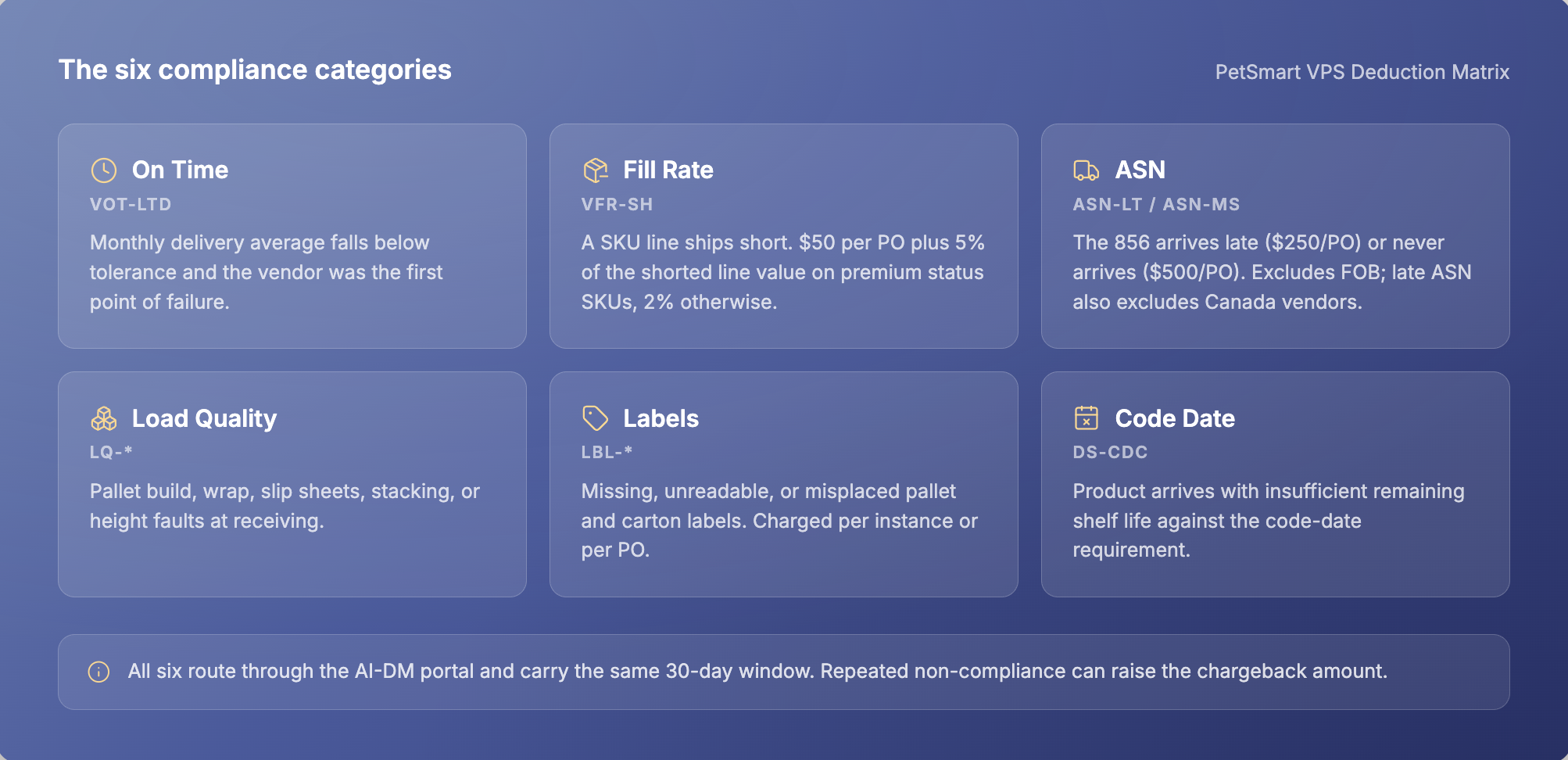
PetSmart manages all compliance deductions through a third-party portal called AI-DM (Active Intelligence Deduction Management), hosted by OpenText. When a compliance deduction posts off your invoice, it carries a unique Foreign ID beginning with "AI" (for example, "AI_12345"). You use that ID to locate the deduction in the portal and decide whether to approve, inquire, or dispute. This is the channel for all six compliance deduction categories covered by PetSmart's Vendor Performance Standards, and a direct driver of CPG margin leakage when left unmanaged.
The six categories, and what triggers each one:
- PO On Time: Charged when a PO arrives at a PetSmart DC after the PO Due Date and the vendor was the first point of failure. PetSmart reviews on-time performance at the end of each fiscal month and only charges if the average falls below tolerance for that month.
- PO Fill Rate: Charged when a SKU line quantity received is below tolerance. Each violation carries a $50 admin fee plus a percentage of the shorted SKU line value, which varies by SKU status code.
- ASN Compliance: Charged when an ASN is late or missing. An ASN is considered late when it is not received before the PO is checked in at the DC guard station. The 856 must be submitted within one hour of the shipment leaving the facility.
- Load Quality: Charged per pallet or per truckload for violations including missing slip sheets, overhang, pallet height issues, pallet quality failures, improper stretch wrap, and tipped pallets.
- Labels: Charged for non-compliant or missing GS1-128 labels. Pallets require GS1-128 labels on each 40-inch side. Check your vendor agreement for any additional carton-level label requirements, as these can vary by shipment type.
- Code Date: Charged when product does not meet PetSmart's minimum shelf life requirement at the time of DC receipt. Check your vendor agreement for the specific shelf life threshold, as it varies by product category.
PetSmart also collects a defective and unsellable product allowance at the end of each fiscal year. This covers product written off at the DC or store level as damaged, past code date, returned, or otherwise unsellable, collected off invoice or via manual check for amounts above the minimum threshold. This annual collection is separate from the per-event compliance deductions above.
You have 30 days from the date a compliance deduction is created to dispute it through the AI-DM portal. After that window closes, the deduction stands as filed without further review.
Portal access is not automatic. New vendors must complete PetSmart's new-vendor orientation and designate an admin contact before they can log in. Without that step, there is no way to view, approve, or dispute any deduction, no matter how strong the documentation.
Shortage Deductions: When PetSmart Claims It Received Less Than Invoiced
Shortage deductions are among the most disputed charge types at PetSmart. The retailer submits a claim saying it received fewer units than your invoice reflects, then deducts the difference from your payment. The problem is that those claims can be wrong. RVCF research on shortage claim validity puts the invalid rate at 60 to 70% across mid-market CPG brands. Our own data shows that 40-50% of shortage deductions are invalid. See how pet CPG brands recover invalid retail deductions before the dispute window closes.
Carriers sign off on full shipments. BOLs confirm delivery. Glimpse disputes those claims before the deadline expires.
When you receive a shortage claim, pull the POD documentation and cross-reference it against the BOL. If the carrier confirmed full delivery, you have grounds to dispute. BOLs and PODs are critical evidence in shortage disputes; without them, PetSmart will not research the claim.
To dispute, email a complete documentation packet to proofofdelivery@petsmart.com within 30 days. PetSmart's Research Desk reviews claims on a first-come, first-served basis and allows up to 90 days for research. Submitting an incomplete packet means it comes back unresearched. Get everything together before you send it.
PetSmart's Payment Terms and Key Deadlines
PetSmart's standard payment terms are Net 70 days. The payment cycle begins with the later of the invoice date or the date of goods receipt. Invoices must be submitted within 90 days of the PO ship date; PetSmart will not pay invoices submitted after that window.
The dispute window for compliance deductions is 30 days from the date the deduction is created. Miss it and the deduction stands as filed with no further review. Shortage claims also carry a 30-day window, submitted via email to proofofdelivery@petsmart.com. Pricing discrepancies go to your PetSmart buyer directly.
That 30-day clock starts from the deduction creation date, not from when you notice it. For brands reviewing deductions manually or in batches, claims age out before anyone acts on them. One missed deduction may be small. A month of missed deductions at volume adds up fast.
How PetSmart Uses EDI for Purchase Order Transmission
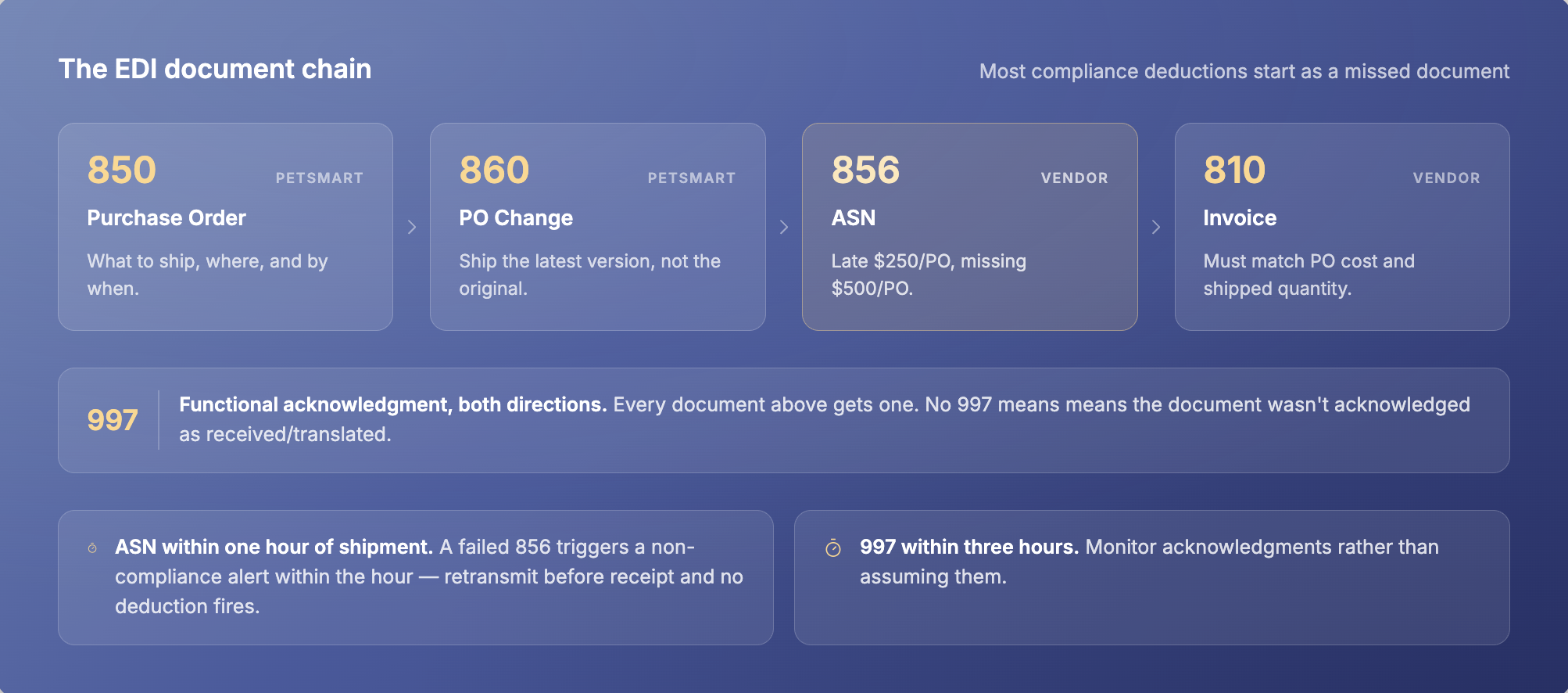
PetSmart relies on Electronic Data Interchange (EDI) to manage purchase orders across its supplier network, with OpenText as its managed services EDI partner. When a vendor ships product, that transaction flows through a standardized EDI pipeline governing everything from order acknowledgment to invoice submission. PetSmart EDI compliance requirements span ANSI X12, AS2/VAN, and core documents including the 850, 856, and 810, and mismatches in any of them can trigger automatic deductions. Managing multiple retailers through a single platform is the most efficient way to handle this complexity.
The mandatory EDI documents in this flow are:
- EDI 850 (Purchase Order): PetSmart sends this to initiate a buy. It contains item numbers, quantities, ship-to locations, and pricing expectations.
- EDI 860 (Purchase Order Change Request): PetSmart uses this to communicate changes to an existing PO. Vendors are required to consume 860s and update orders accordingly.
- EDI 856 (Advance Ship Notice): Must be submitted within one hour of the shipment leaving the vendor's facility. PetSmart must receive and process the ASN before goods arrive at the DC.
- EDI 810 (Invoice): The vendor's billing document, which PetSmart matches against the 850 and 856 during payment processing.
- EDI 997 (Functional Acknowledgment): Required within 3 hours of receiving any EDI document from PetSmart. OpenText automatically generates follow-up notices if a 997 is not received within 24 hours.
When any of these documents contain mismatches or quality issues, PetSmart's systems flag the discrepancy and a deduction often follows automatically, before a human ever reviews it.
Why Pet CPG Brands Are Especially Vulnerable to Deduction Leakage
Pet CPG brands carry a structural disadvantage that general grocery brands don't face to the same degree. The category skews heavily toward specialty retail, meaning a disproportionate share of revenue flows through accounts like PetSmart, Petco vendor deductions, and independent pet chains each carrying their own deduction policies, compliance requirements, and chargeback codes, with dispute processes as complex as those at any major retailer (see our Walmart deductions guide for a comparable breakdown).
That concentration creates real risk. In Glimpse's experience working with pet CPG brands, it's common for one retailer to represent 30 to 50 percent of revenue. When that's the case, their deduction behavior has an outsized impact on your cash flow. A spike in shortage claims or a new compliance fee policy won't get averaged out across a broad retailer mix.
Category-Specific Pressures That Compound the Problem
Pet CPG also tends to run on thinner operational margins than mass-market categories, making deduction leakage harder to absorb and recoverable cash harder to recoup.
- Seasonal demand spikes around holidays and pet adoption trends create fulfillment pressure, which increases the likelihood of shortage deductions and on-time/in-full penalties.
- Premium and specialty SKUs often have complex promotional structures, which means more trade spend activity and more surface area for deduction disputes.
- Smaller finance teams at growing pet brands frequently lack the bandwidth to work every deduction, so invalid claims go unchallenged and get written off as a cost of doing business.
Invalid deductions are recoverable revenue. Turning disputed deductions into recovered revenue requires a systematic approach, and every day without one is a day you're writing off valid claims.
Catching On-Time Failures Before They Post as Deductions
The cheaper move is upstream. PetSmart runs a Detailed Overall Failure Report every Wednesday covering on-time (VOT-LTD) failures from the prior period. Vendors have 48 hours to comment on any failure before it uploads to the AI-DM portal the following Monday and becomes a live deduction. A brand that works this report catches invalid charges before the 30-day dispute clock ever starts.
Two lead-time disciplines keep on-time performance clean before the Wednesday report runs. Collect vendors should create the shipment release at least 48 hours before the Must-Ship-By date. Prepaid vendors should book the DC appointment through Uber Freight's TMS at least 48 hours before the PO Due Date. The ASN also generates a one-hour non-compliance alert if it doesn't transmit correctly; treat that alert as a retransmit window before the failure is recorded.

How On-Time Tolerance Actually Works
PetSmart measures on-time performance as a fiscal-month average, not per PO. A VOT-LTD fee only posts when the monthly average falls below tolerance and the vendor was the first point of failure. One late delivery in an otherwise clean month may not generate a deduction at all. And if the delay traces to a carrier missing a Collect pickup, a PetSmart-side appointment issue, a weather event, or a PO date change, the vendor is not the first point of failure. Those are winnable disputes, and naming the actual cause is what wins them.
How to Dispute PetSmart Deductions
PetSmart uses three separate dispute channels depending on the deduction type. Routing a claim to the wrong channel means it does not get reviewed.
| Deduction Type | Dispute Channel | Deadline | Required Documentation |
|---|---|---|---|
| Compliance deductions (On Time, Fill Rate, ASN, Load Quality, Labels, Code Date) | AI-DM portal (OpenText): locate by "AI_" Foreign ID | 30 days from deduction creation date | Supporting docs + comment explaining the dispute |
| Shortage and damage discrepancies | Email to proofofdelivery@petsmart.com | 30 days from claim date | Original invoice, packing list, signed POD (prepaid) or BOL (collect), PetSmart invoice reduction report |
| Pricing discrepancies | Contact your PetSmart buyer directly | Contact buyer promptly | N/A; handled with the buyer |
Channel 1 - Compliance deductions (PO On Time, Fill Rate, ASN, Load Quality, Labels, Code Date): Dispute through the AI-DM portal. Locate the deduction using its "AI_" Foreign ID, attach supporting documents, and add a comment explaining the dispute. You have 30 days from the deduction creation date. After that, the deduction stands as filed.
Channel 2 - Shortage and damage discrepancies: Do not use the AI-DM portal. Email a complete documentation packet to proofofdelivery@petsmart.com within 30 days. The packet must include: a copy of the original invoice, the packing list, a signed POD (if freight was prepaid) or signed BOL (if freight was collect), and a copy of the PetSmart invoice reduction report. If you need the invoice reduction report, contact accountspayable@petsmart.com. Incomplete packets are returned without research and resubmission restarts the process. Allow up to 90 days for the Research Desk to complete their review.
Channel 3 - Pricing discrepancies: Contact your PetSmart buyer directly. Pricing disputes do not go through the portal or the Proof of Delivery department.
For compliance deductions, sort your open cases by deduction creation date and work oldest-first. A valid deduction at day 29 is fully disputable. At day 31, it is gone permanently with no further review.
How Glimpse Manages PetSmart Deductions for Pet CPG Brands
Glimpse takes PetSmart deduction management off your team's plate entirely. From the moment a deduction posts, our AI agents classify it, pull the relevant backup documentation, and queue it for dispute, with human experts reviewing and escalating every case that needs judgment before the window closes.
For PetSmart, that means emailing documentation packets to PetSmart's Research Desk for shortage claims, disputing compliance deductions through the AI-DM portal, and building evidence packets that hold up under review. Our team knows which deduction codes are worth fighting and which require a different approach.
A few things Glimpse handles on your behalf:
- Shortage deductions are matched against shipping documentation to confirm whether the claim is valid or inflated.
- Compliance deductions are reviewed against your current PetSmart vendor agreement to catch misapplied fees.
- Advertising and markdown deductions are reconciled against your signed promotional calendar to flag anything that wasn't authorized.
- Every dispute is tracked through resolution so nothing falls through the cracks before the deadline expires.
This reflects what we've learned working with 200+ CPG brands, processing over $1 billion in invoice volume, including brands scaling through major pet specialty retailers where deduction volume grows faster than headcount ever could. Chewy vendor deductions and Petco are also Glimpse integrations for pet brands that sell across other major pet specialty accounts.
See how Evermark identified 17,000 shortage deductions with Glimpse's managed service, and how Glimpse's shortage agent created a 7-figure return for their team.
Frequently Asked Questions
Which retailers and distributors does Glimpse currently support?
Glimpse currently supports deductions management across a growing list of major retailers and distributors, including Walmart, Sam's Club, Target, Kroger, Amazon 1P, Walgreens, Ulta Beauty, Sephora, PetSmart, H.E.B., Meijer, BJ's, Whole Foods, KeHE, and UNFI. We're continuously onboarding new retailers and distributors, so if you don't see yours listed, reach out. There's a good chance it's already on our roadmap or in active development.
Does Glimpse integrate with our ERP and accounting systems?
Yes. Glimpse integrates directly with QuickBooks and NetSuite, syncing with your ERP and accounting systems so deduction data, backup, and recovery flow into your existing financial workflows without manual re-entry. If you use a different system, reach out. We're regularly expanding our integrations.
How does Glimpse keep our data secure?
Security and data privacy are foundational to how we operate. Glimpse is SOC 2 Type 1 compliant, and we're currently undergoing our SOC 2 Type 2 audit to further validate the ongoing effectiveness of our security controls. We follow enterprise-grade practices for data encryption, access control, and secure system integration (including your ERP), so your financial data stays protected at every step.
Final Thoughts on Recovering Revenue From PetSmart Deductions
Brands that dispute before day 30 recover claims PetSmart would otherwise close permanently. Your documentation exists. Your contracts exist. Talk to Glimpse and put that revenue back where it belongs.
FAQ
What is PetSmart's deduction dispute deadline and what happens if you miss it?
PetSmart gives vendors 30 days from the date a compliance deduction is created to dispute it through the AI-DM portal. Shortage and damage claims also carry a 30-day window, submitted via email to proofofdelivery@petsmart.com. Once either window closes, the deduction stands as filed without further review, and PetSmart will not reopen the case.
How do you dispute a shortage deduction at PetSmart?
Shortage disputes do not go through the AI-DM portal; they go via email. Within 30 days of the shortage claim, email a complete packet to proofofdelivery@petsmart.com. The packet must include: original invoice, packing list, signed POD (prepaid shipments) or signed BOL (collect shipments), and the PetSmart invoice reduction report. Incomplete packets are returned without research, so send everything together. The Research Desk allows up to 90 days to review complete claims on a first-come, first-served basis.
PetSmart shortage deductions vs. compliance deductions: what's the difference and how do you fight each one?
Shortage deductions are claims that fewer units arrived than were invoiced, disputed by submitting BOL and POD documentation confirming full delivery. Compliance deductions are penalties for how a shipment was prepared or transmitted, such as a late ASN or missing GS1-128 labels, and require different evidence like ASN timestamps or carrier records confirming on-time DC arrival by the PO due date.
Why are pet CPG brands more exposed to PetSmart vendor deductions than general grocery brands?
Pet CPG brands often run 30 to 50 percent of their revenue through a single account like PetSmart, meaning one retailer's deduction policies have an outsized hit on cash flow with no other channels to offset it. Smaller finance teams at scaling pet brands frequently lack the bandwidth to dispute every claim before deadlines expire, so invalid deductions get written off as routine losses.
Can Glimpse manage PetSmart deduction disputes without your team pulling backup documentation or logging into the vendor portal?
Yes. Glimpse's AI agents retrieve backup documentation, classify each deduction by type, and route it to the correct channel: compliance deductions go through the AI-DM portal, shortage and damage claims go to proofofdelivery@petsmart.com with the full required packet. Human experts review and escalate every case before the 30-day window closes. Your team does not need to pull the documents, classify deductions, or track submission dates. This reflects what we've learned working across 200+ CPG brands where deduction volume scales faster than any finance team can manually cover.
AI deduction management software vs. outsourced deduction services: which is better for CPG brands?
The most effective approach combines both. Pure software tools give your team a dashboard and workflow, but someone on your staff still has to classify deductions, pull backup, write dispute rationale, and track deadlines across every retailer. Outsourced services handle execution but can be slow, opaque, and hard to scale when deduction volume spikes. Glimpse is a fully managed service built on AI: agents handle classification, documentation retrieval, and routing automatically, while human experts review and file every dispute before the window closes. You get the speed and coverage of automation without the manual workload of a software-only tool.
How do you recover cash from invalid chargebacks that retailers deduct from your invoices?
Recovery starts with identifying which deductions are invalid. For shortage-type chargebacks, that means cross-referencing the retailer's claim against your BOL and signed proof of delivery. If the carrier confirmed full shipment, the claim is disputable. For compliance chargebacks, compare the deduction against your vendor agreement to catch misapplied fees or rate errors. Once you have supporting documentation, submit a dispute through the retailer's designated channel before the deadline (30 days at PetSmart). Incomplete packets or wrong-channel submissions reset the clock or close the case entirely. Systematic recovery requires working every deduction against its deadline, including the smaller ones.
What's the best software to automatically dispute invalid retailer deductions for a CPG brand?
Glimpse is built for exactly this. When a deduction posts, Glimpse's AI agents classify it by type, retrieve the relevant backup documentation, and route the dispute to the correct channel for each retailer: the AI-DM portal for PetSmart compliance deductions, the proof-of-delivery email for shortages, and equivalent paths across Walmart, Target, Kroger, Amazon 1P, and 15+ other retailers. Human experts review every case before submission. The result is full coverage of your deduction queue without requiring your finance team to log into vendor portals, pull documents manually, or track 30-day deadlines across accounts.
How does Glimpse handle compliance deduction disputes end-to-end, including backlogged uncontested deductions?
When a compliance deduction posts, Glimpse's AI agents classify it, retrieve supporting documentation, and queue it for dispute through the correct channel (the AI-DM portal for PetSmart compliance deductions) before the 30-day window closes. For brands onboarding with a backlog of uncontested deductions, Glimpse works through aged claims in parallel, focusing first on those still within the dispute window. Human experts review every case before submission and escalate anything that requires judgment. Your team does not need to classify deductions, pull documents, or track deadlines.
How does Glimpse distinguish between valid promotional deductions and invalid logistics or freight deductions?
Glimpse classifies every deduction by type at intake (promotional allowances, shortage claims, compliance fees, freight charges) and validates each against your vendor agreement and signed promotional calendar. Valid promotional deductions are approved; deductions that don't match an authorized promotion or that exceed contracted rates are flagged as disputable. Glimpse also surfaces trend data by deduction category so your team can see what's driving volume spikes. For example, a rise in ASN compliance fees after a carrier change, or a spike in shortage claims from a specific DC.
How does Glimpse handle deductions when PetSmart provides no backup documentation or uses short dispute windows?
When PetSmart provides no backup documentation for a deduction, Glimpse requests it directly and cross-references the claim against your own shipping records: BOLs, signed PODs, ASN timestamps, and carrier confirmations. For PetSmart's 30-day compliance and shortage dispute windows, Glimpse monitors every open deduction against its creation date and files before the deadline regardless of whether backup has been received from the retailer. Claims where documentation cannot be obtained are flagged for human review and not written off automatically.
How does Glimpse handle the redispute process when a deduction dispute is initially denied?
When PetSmart denies a dispute, Glimpse reviews the denial reason and determines whether the claim is eligible for redispute. If additional documentation, such as a carrier pickup confirmation or corrected ASN timestamp, can strengthen the case, Glimpse prepares and refiles the dispute. Cases that are denied without a valid basis are escalated for human expert review. Your team is notified of denial outcomes and redispute decisions so there is full visibility into each case without requiring manual tracking.
About the Author
Anuj Mehta is co-founder and COO at Glimpse, where he oversees the customer journey from onboarding to ongoing success. He has worked with hundreds of retail brands to understand their pain points and deliver direct value with Glimpse's AI solutions.
About Glimpse
Glimpse is a deduction management service built for CPG brands selling through distributors and major retailers. Glimpse automates the entire deductions process: from coding and validation to dispute resolution, using AI agents trained on distributor- and retailer-specific rules. Glimpse automates the workflows overwhelming manual teams, disputing all the invalid deductions that manual teams can't address.
With Glimpse, over 200 brands have recovered invalid deductions, eliminated manual work, and improved bottom-line performance without adding headcount. Glimpse has processed over $1 billion in invoice volume. Backed by Andreessen Horowitz. Based in New York.